

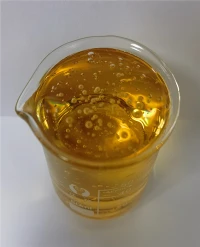

Side-by-side comparison at 2% solids in toluene. Left: oil dispersion before propylene carbonate activation. Right: homogeneous gel after activation.
Cosmetic formulators who rely on BENTONE® 38VCG for suspension and rheology control often hit supply-side friction - longer lead times, inconsistent pricing, and limited flexibility on packaging volumes. Disteardimonium Hectorite (CAS 94891-31-3), produced by Alfa Chemical in Zhengzhou, China, shares the same INCI name and CAS number as BENTONE® 38VCG. That means a technically equivalent alternative is available without reformulation.
What Is Actually the Same - and What to Verify
Both materials are organically modified hectorite clays. They activate the same way - a polar activator, typically propylene carbonate, is required to build the viscosity network. Dosage ranges overlap: 3–10% for suspension, 3–5% for thickening in medium-to-low polarity oils.
The difference lies in batch-level verification. Before switching, run a side-by-side test at the same dosage and activation protocol. The five tests below cover the dimensions that matter most in cosmetics.
Side-by-Side Test Plan
1. Appearance & Particle Size
Check color against the reference and confirm 95–100% passes through 200 mesh with no visible agglomerates.
2. Gel Viscosity After Activation
Prepare a 2% dispersion in toluene with propylene carbonate at 15–35% on clay weight. Measure Brookfield viscosity after 15 minutes at 1,000–2,000 rpm.
3. Thixotropic Recovery
Run a shear-recovery cycle at 100 s⁻¹ then 1 s⁻¹. Compare viscosity recovery profiles between the two materials.
4. Pigment Suspension
Build the same foundation or sunscreen base with both materials. Store at 45°C for 4 weeks and check for sedimentation or color streaking.
5. Heat Stability
Accelerated aging at 45°C for 4 weeks. Both samples should remain phase-stable without syneresis or gel collapse.
Adjustments That May Be Needed
In most systems, no change is required. If viscosity differs after the first trial, test these three variables in order:
- Activator dosage - try 15%, 25%, and 35% propylene carbonate on clay weight. A 10% shift can change final viscosity noticeably.
- Dispersion time - some lots need an extra 5 minutes at 2,000 rpm to reach full gel clarity.
- Order of addition - add clay to the oil phase before the polar activator. Reversing the order can produce a lumpy dispersion.
Supplier Qualification Checklist
When qualifying a new supplier for Disteardimonium Hectorite, ask for:
- Batch-specific COA covering purity, moisture, bulk density, and microbial content
- SDS and TDS with test methods listed
- Heavy metal statement (Pb, As, Hg, Cd) against your target market's limits
- A 1 kg evaluation sample for side-by-side testing
- Written activation procedure recommendation
How Alfa Chemical Supports the Switch
Alfa Chemical manufactures Disteardimonium Hectorite (CAS 94891-31-3) at our Zhengzhou facility. Packaging runs from 1 kg lab samples to 25 kg production drums. Every batch ships with a batch-specific COA and SDS; retain samples are kept for 24 months. We can walk you through propylene carbonate activation for your specific oil phase.
For related materials, see our Cosmetic Chemicals catalog or the Isododecane (CAS 31807-55-3) page - a common dispersion medium for organoclay systems. For sample requests or technical questions, contact our team.
About Alfa Chemical
Alfa Chemical is based in Zhengzhou, China, and supplies cosmetic and industrial chemicals with batch-specific documentation. For more information on the product line, visit our main site.
BENTONE® is a registered trademark of Elementis. Alfa Chemical is not affiliated with Elementis. This information is for R&D and formulation use only. Users are responsible for verifying compliance with local cosmetic regulations.