



Published by Alfa Chemical Technical Team | Keywords: Heptyl Butyrate, CAS 5870-93-9, Acid Value, Flavor & Fragrance
In the formulator's library of raw materials, Heptyl Butyrate (CAS 5870-93-9) often wears two distinct hats. It is a common ester used in food and personal care formulations to provide chamomile and tropical fruity notes, but it is also a well-documented chemical attractant for western yellowjackets in entomological research.
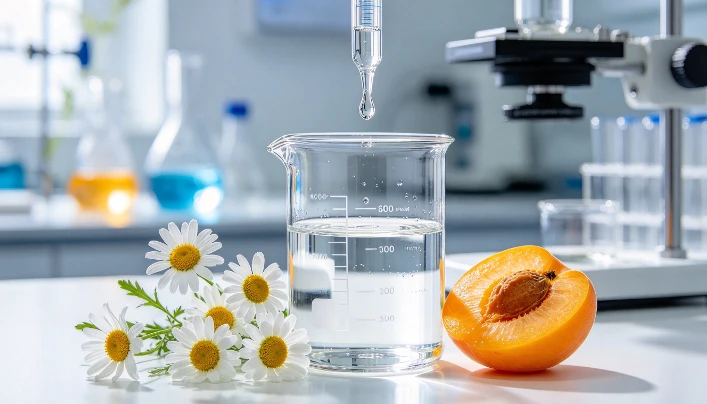
Heptyl Butyrate bridges natural fruity aromas with precise laboratory titration for strict acid value control.
This cross-industry application highlights a critical metric that procurement and formulators often overlook when evaluating this raw material: Acid Value. If you only focus on Gas Chromatography (GC) purity and ignore the control of free acids, the final product may not smell like chamomile-it might smell like pungent, rancid sourness.
1. Sensory Profile: Fruity and Tea-like Nuances
The odor profile of Heptyl Butyrate is highly distinct. It presents as a colorless clear liquid with a primary scent that combines sweet fruity notes with chamomile, accompanied by the green, fresh nuances of green tea.
In food flavoring, it is frequently used to construct stone fruit flavors such as apple, apricot, and plum, and can provide a natural background note for tea beverages and baked goods. In daily chemical fragrances, it acts as a stable mid-note. Its moderate evaporation rate aligns well with the usage cycle of personal care products, providing a relatively long-lasting olfactory experience.
2. The Overlooked Quality Metric: Acid Value Defines Odor Purity
During synthesis or storage, if ester hydrolysis is not properly controlled, free butyric acid will be released. Butyric acid itself has a strong, rancid, and unpleasant odor. Even trace residues can severely disrupt the fresh fruity and tea-like profile of Heptyl Butyrate. Therefore, Acid Value is the critical threshold for measuring its quality, and its importance is arguably no less than the main content purity.
The industry standard for high-quality Heptyl Butyrate requires the Acid Value to be controlled at ≤ 1.0 mg KOH/g. For premium flavor and fragrance applications, more stringent specifications may require values approaching zero. At Alfa Chemical's Zhengzhou facility, we treat acid value control as a mandatory release criterion. Every batch must pass titration to verify free acid content, ensuring the raw material delivered does not cause entire batches of fragrance to be scrapped due to rancidity.
3. Formulation Compatibility: Alcohol and PG Systems
For formulators, solubility dictates the feeding process. Heptyl Butyrate is insoluble in water but highly soluble in ethanol and propylene glycol (PG). This makes it highly suitable for hydro-alcoholic systems (such as perfumes and after-shaves) and liquid flavor concentrates using PG as a carrier. For emulsion systems, appropriate solubilizers or co-solvents should be evaluated to prevent precipitation or turbidity in the final product.
4. Specialty Non-Fragrance Application: Pheromones and Attractants
Another noteworthy property of Heptyl Butyrate lies in its biological activity. Research indicates it is an effective chemical attractant for western yellowjackets and several related wasp species. In the North American market, it is a core component in many commercial wasp trap formulations. This application requires strict structural consistency; fluctuations in impurity profiles can directly affect trapping efficiency. For downstream clients engaged in pest management or entomological research, we provide batch-specific GC chromatograms and physicochemical data to support formulation validation.
5. Key Physicochemical Data & Packaging Recommendations
When evaluating Heptyl Butyrate, besides the acid value, the Refractive Index and Density are standard parameters for identification and batch consistency verification. Typical specifications are listed below:
| Parameter | Typical Specification |
|---|---|
| Refractive Index (n20/D) | 1.4215 |
| Relative Density (25°C) | 0.864 g/mL |
| Acid Value | ≤ 1.0 mg KOH/g |
Regarding packaging, ester products should avoid prolonged contact with iron ions to prevent catalyzed hydrolysis. We recommend using epoxy-phenolic lined steel drums or high-density polyethylene containers, stored in a cool, dry place away from direct light. Standard packaging ranges from 1kg sample packs to 25kg pails and 200kg drums, ensuring a smooth transition from lab-scale screening to industrial production.
About the Manufacturer & Technical Support:
As a direct manufacturer based in Zhengzhou, China, Alfa Chemical supplies Heptyl Butyrate with full COA, SDS, and KOSHER certifications. If you are facing challenges with acid value limits in your current supply chain, or if you require a related butyrate ester (e.g., Hexyl Butyrate, Octyl Butyrate) for your formulation, our technical team is here to assist.
Send us your target specification and required quantity. We will reply with matching batch data, sample arrangements, and pricing details. Contact our technical team here. You can also browse our full range of Industrial Chemicals.
Share this article: Alfa Chemical Technical Team. "From Chamomile to Wasp Attractant: The Formulation Logic and Acid Value Control of Heptyl Butyrate." Alfa Chemical Knowledge Base, 20 Oct. 2026, https://www.alfa-industry.com/info/from-chamomile-to-wasp-attractant-the-formula-103707656.html.
Disclaimer: This article is intended for industrial and research reference only. It is the buyer's responsibility to ensure that the product is used in compliance with all applicable local laws, regulations, and safety standards. All specifications are typical values and should be confirmed against the batch-specific Certificate of Analysis before use.