




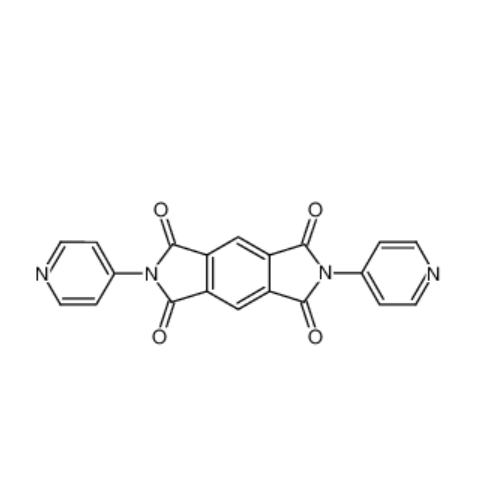
Introduction of CAS:34072-51-0 | N,N'-di-(4-pyridyl)-1,2,4,5-benzenetetracarboxydiimide
Pyrrolo[3,4-f]isoindole-1,3,5,7-tetraone, 2,6-di(pyridin-4-yl)- is a heterocyclic compound that has gained significant attention in the field of medicinal chemistry due to its unique chemical and biological properties.
Specification of CAS:34072-51-0 | N,N'-di-(4-pyridyl)-1,2,4,5-benzenetetracarboxydiimide
|
ITEMS |
SPECIFICATION |
|
Boiling point |
679.9±65.0 °C(Predicted) |
|
Acidity coefficient (pKa) |
6.06±0.10(Predicted) |
|
Density |
1.606±0.06 g/cm3(Predicted) |
|
Purity |
97% |
Research Application of CAS:34072-51-0 | N,N'-di-(4-pyridyl)-1,2,4,5-benzenetetracarboxydiimide
Metal-Organic Complexes and Supramolecular Isomerism
The compound has been utilized in the synthesis of metal-organic complexes showcasing cage-opening supramolecular isomerism. Reactions involving semirigid ligands similar to the specified compound with copper salts result in the formation of metal-organic complexes with varied structures, including tetragonal prismatic cages and network metal-organic frameworks. These complexes exhibit interesting photoluminescence properties, indicating potential applications in materials science and photonic devices (Yu et al., 2017).
Organic Field-Effect Transistors
A derivative of the mentioned compound has been synthesized and utilized in the development of conjugated polymers for ambipolar field-effect transistors. These polymers demonstrate good solubility, thermal stability, and promising electronic properties, making them suitable for application in solution-processed organic field-effect transistors (Shao et al., 2014).
Solid-State Structures and Thermal Stability
The solid-state structure and thermal stability of derivatives have been examined, with studies highlighting their insolubility and potential for constructing porous materials. The unique structural characteristics of these compounds allow for their application in materials science, particularly in the development of materials with high porosity for nano-sized guest hosting (Maspero et al., 2013).
Polymer Chemistry and Optically Active Polymers
Derivatives have also been employed in the synthesis of novel optically active poly(amide-imide)s. These polymers, derived from reactions involving a chiral diacid precursor related to the target compound, exhibit high thermal stability and amorphous morphology. Their solubility in various organic solvents and ability to form transparent films suggest potential applications in optoelectronic devices and materials science (Zamanloo et al., 2011).
Highly Luminescent Polymers
Research has been conducted on the synthesis of highly luminescent polymers incorporating tetraarylated derivatives. These studies focus on developing polymers with strong fluorescence, high quantum yields, and solubility in common organic solvents, indicating their potential use in the fields of photonic materials and organic electronics (Zhang & Tieke, 2008).

Hot Tags: cas:34072-51-0 | n,n'-di-(4-pyridyl)-1,2,4,5-benzenetetracarboxydiimide, China cas:34072-51-0 | n,n'-di-(4-pyridyl)-1,2,4,5-benzenetetracarboxydiimide manufacturers, factory, Methyltin mercaptide, Biurea, Epsilon-polylysine, 1 3 Diisopropenylbenzene, Reactive Red 195, 3 5 DI TERT BUTYLBENZOIC ACID

![CAS:888721-83-3 | 6-broMopyrrolo[1,2-f][1,2,4]triazin-4(3H)-one](/uploads/202340266/small/cas-888721-83-3-6-bromopyrrolo1091bfbc-62da-4caa-b84b-3e31205ee646.png?size=195x0)


